
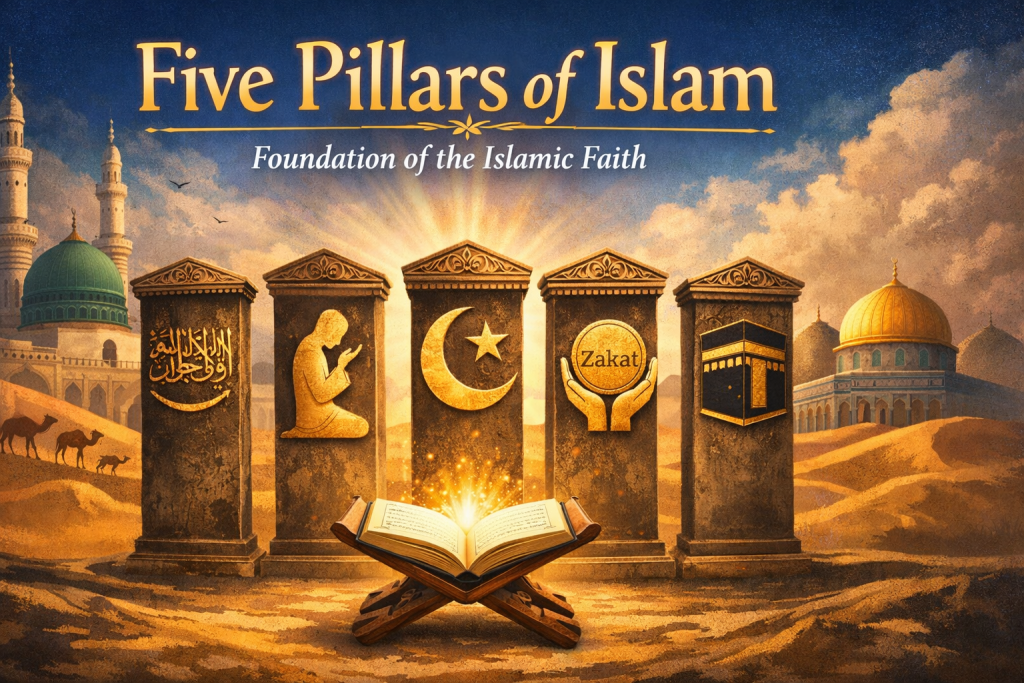
Just as a strong and stable building stands firmly on five solid pillars, Islam is also built upon a strong foundation known as the Five Pillars of Islam. These pillars form the core structure of Islam and ensure its strength and completeness. They teach Muslims how to worship Allah properly and how to build a strong and meaningful connection with their Creator. Observing these pillars is obligatory for all Muslims and serves as a clear recognition of one’s faith and identity as a Muslim.
This guide will explain the Five Pillars of Islam, their meanings, and their importance in shaping a strong and well-balanced Muslim identity.
What Are the 5 Pillars of the Islamic Faith?
The pillars of Islam are clearly explained in a hadith.
The Prophet Muhammad ﷺ said:
“Islam is built upon five pillars: testifying that there is no god but Allah and that Muhammad is the Messenger of Allah, establishing prayer, giving zakat, fasting in Ramadan, and performing Hajj for those who are able.”
—Sahih al-Bukhari & Sahih Muslim
According to this Hadith, Islam is built upon 5 pillars. These are:
- Shahada (Faith)
- Salah (Prayer)
- Zakat (Charity)
- Sawm (Fasting in Ramadan)
- Hajj (Pilgrimage to Makkah)
1. Shahada – Declaration of Faith
The word Shahadah literally means to bear witness. In the Islamic context, Shahadah refers to openly declaring with the tongue and sincerely accepting in the heart the Oneness of Allah. It is the first, most fundamental, and most essential pillar of Islam.
A person cannot be considered a Muslim without accepting the Shahadah, as it affirms the belief that Allah is One, that He alone is worthy of worship, and that the Prophet Muhammad ﷺ is the Messenger of Allah, as expressed in the declaration.
“أشهد آن لاإله إلا الله، وأشهد أن محمداً رسول الله”
“Ash-hadu an la ilaha illa Allah, Wa ash-hadu anna Muhammadan Rasulu-Allah.”
“I bear witness that there is no God (worthy of worship) but Allah, and Muhammad is the Messenger of Allah.”
The declaration of Shahadah is the very first gateway to entering Islam and forms the foundation of a Muslim’s faith and identity.
2. Salah – Performing Daily Prayers
After affirming the Oneness of Allah through the Shahadah, the second essential pillar of Islam is Salah, or the daily prayers. Muslims are required to perform five daily prayers at their prescribed times, as each prayer has its specific time of performance. These prayers serve as a distinguishing practice between a Muslim and a non-Muslim. The purpose of Salah is to remember Allah, worship Him, and show gratitude for His countless blessings.
The five daily prayers are:
- Fajr (Dawn Prayer)
- Dhuhr (Noon Prayer)
- Asr (Afternoon Prayer)
- Maghrib (Sunset Prayer)
- Isha (Night Prayer)
These prayers help maintain a strong connection with Allah throughout the day.
3. Zakat – Giving Charity
Zakah, in its literal meaning, refers to purification or cleansing. In Islam, Zakah is a form of obligatory charity prescribed by Allah for those who possess wealth (gold, silver, or cash) above a certain threshold. People who meet this minimum wealth requirement are called Sahib-e-Nisab. Every year, these individuals are required to give 2.5% of their eligible wealth to those who are deserving and in need.
Allah commands in the Quran:
“Establish prayer and give zakat…”
—Surah Al-Baqarah 2:43
Far from reducing one’s wealth, giving Zakah or Sadaqah brings blessings and purification to one’s wealth, increasing its barakah (divine blessings).
As told by the Messenger of Allah:
“Wealth never decreases because of charity.”
—Muslim, 2588
The primary purpose of Zakah is to establish financial balance in society and to provide support for those who are modest and self-respecting, who might otherwise hesitate to ask for help. By fulfilling this pillar, Muslims contribute to social justice while purifying their wealth in the sight of Allah.
4. Sawm – Fasting in the Month of Ramadan
Sawm is an Arabic term that means fasting. It is the fourth pillar of Islam. Fasting refers to abstaining from all food, drink, and sinful behavior from dawn (Fajr) until sunset (Maghrib) during the month of Ramadan.
Allah says:
“O you who believe, fasting has been prescribed for you as it was prescribed for those before you, so that you may become righteous.”
—Surah Al-Baqarah 2:183
Fasting is obligatory for every adult Muslim who is sane and physically capable. Exemptions are given to children, the elderly, the sick, and pregnant or nursing women. For those required to fast, it is a spiritual duty that serves as a means to attain Taqwa, or God-consciousness.
The purpose of Sawm is to develop self-discipline, patience, and gratitude, while also fostering empathy for the less fortunate. It helps believers stay mindful of Allah throughout the year and strengthens their faith and spiritual awareness.
5. Hajj – Pilgrimage to Makkah
The fifth and final pillar of Islam is Hajj. It is a pilgrimage to the holy city of Makkah, required once in a lifetime for Muslims. It is performed annually from the 8th to the 12th of Dhul-Hijjah, the 12th month of the Islamic calendar.
Allah says in the Quran:
“And pilgrimage to the House is a duty owed to Allah by people who are able to undertake it.”
—Surah Aal-e-Imran 3:97
Muslims from all over the world gather in Makkah to perform a series of sacred rituals, many of which are carried out while wearing a simple, unstitched white garment called an Ihram.
Hajj is obligatory only for those who are physically and financially able to undertake the journey. It is a demonstration of devotion, submission to Allah, and spiritual renewal. The primary purpose of Hajj is to establish unity and equality among all Muslims, showing that in the eyes of Allah, no one is superior to another—whether rich or poor, Arabic or non-Arabic traveler or resident, all stand equal in worship.
5 Pillars and Their Impact on Life
The Five Pillars of Islam are not only the foundation of a Muslim’s faith but also profoundly shape every aspect of a believer’s life. Each pillar carries its unique purpose and spiritual benefits:
— Shahadah builds a strong belief in the Oneness of Allah and gives Muslims a clear sense of purpose in life.
— Salah fosters discipline, spiritual peace, and a constant connection with Allah throughout the day.
— Zakah encourages generosity, compassion, and social justice, helping to support the less fortunate in society.
— Sawm strengthens self-control, patience, and faith while fostering empathy for those in need.
— Hajj teaches unity and equality, reminding Muslims that all are equal in the eyes of Allah, regardless of social or economic status.
Conclusion
The five pillars of Islam are not just religious duties; they are a complete system for personal and spiritual growth. They guide Muslims in belief, worship, behavior, and responsibility toward others.
By understanding what the 5 pillars of the Islamic faith are, one can clearly see how Islam focuses on building a strong relationship with Allah and creating a just and caring society. These pillars continue to guide millions of Muslims around the world toward peace, discipline, and righteousness.