
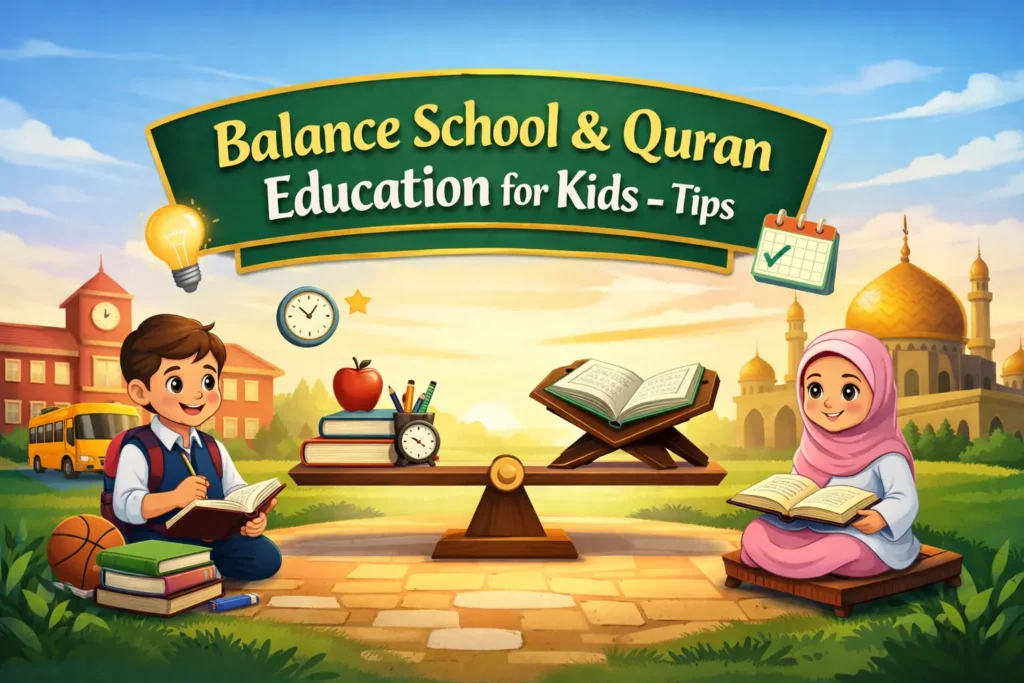
Many Muslim parents strongly desire that their children not only excel in academic education but also develop a strong foundation in Quran learning and Islamic values. However, balancing school studies with Qur’an education has become a real challenge them today. Without a clear plan and proper structure, children can feel overwhelmed, stressed, and may even lose interest in one or both areas.
With the right guidance, a well-organized routine, and consistent support, children can successfully manage both. They can excel academically while building a strong spiritual connection with the Qur’an, achieving true success in this world and the Hereafter. In this article, we will discuss proven strategies on how to balance school and Quran education for kids, ensuring a healthy balance between academic success and Quran learning for children.
Practical Tips to Balance School and Quran Education
1. Create a Consistent Daily Schedule
Consistency is essential for success in a child’s Qur’an learning journey. It helps develop discipline, clarity, and balance, allowing children to manage their priorities effectively. Parents should create a structured daily routine that includes both academic studies and Qur’an education. Scheduling Quran learning at a time when children are mentally fresh and active also ensures better focus and more effective learning.
For example:
Morning – Quran recitation after Fajr prayer
Afternoon – School homework and study
Evening – Revision and practice
2. Prioritize Quality Over Quantity
Parents should prioritize the quality of Quran education over quantity to prevent placing unnecessary pressure on their children. It is far more beneficial for kids to learn smaller portions of the Quran consistently rather than attempting to memorize large sections irregularly. Even 5–10 minutes of focused daily Quran recitation can be more effective than a long, exhausting session. This approach helps children stay engaged, retain their lessons better, and develop a positive and lasting connection with the Quran.
3. Use Interactive Learning Methods
Students learn best when lessons are engaging and interactive. Parents and teachers can make Quran education more enjoyable by using modern teaching methods, such as storytelling from the Quraan, to capture children’s interest and bring the lessons to life.
Today, online Quran classes for kids have become one of the most effective ways to learn Quran. Through interactive one-on-one sessions, students receive guidance from qualified and experienced tutors while learning comfortably from their own homes.
4. Set Realistic Goals
Avoid putting unnecessary pressure on children and don’t overwhelm them with unrealistic expectations. Instead, break Qur’an memorization into small, manageable portions, set daily or weekly goals for schoolwork, and celebrate their achievements to boost confidence and motivation. Focusing on small, consistent progress helps children succeed in the long term while keeping the learning process stress-free and enjoyable.
5. Create a Supportive Learning Environment
Children cannot achieve their best results without a supportive learning environment at home. A quiet, distraction-free space is essential for effective Qur’an education. Parents can help by:
- Providing a dedicated study area for Qur’an recitation and homework
- Limiting screen time during study sessions
- Encouraging family participation in Qur’an recitation
Such an environment helps children develop focus, discipline, and a genuine love for learning, setting the foundation for both academic and spiritual success.
6. Lead by Example
Children naturally imitate their parents and learn from what they observe. When parents recite the Quran regularly in front of their children, it not only sets a positive example but also instills a love for the Qur’an from an early age. Leading by example helps children develop a strong connection with the Qur’an and motivates them to engage with it consistently.
Final Thoughts
Balancing school studies and Qur’an education may seem challenging, but with careful planning, patience, and consistency, it is entirely achievable. By creating a structured routine, focusing on quality over quantity, and making learning engaging, children can excel academically while building a strong spiritual foundation.
The Prophet ﷺ emphasized teaching children the Qur’an and guiding them in knowledge. By following this guidance, parents can raise children who are successful in both this world and the Hereafter—confident in knowledge, strong in faith, and inspired to live by the Qur’an every day.