
Importance of Salah in Islam
Salah is not just a ritual—it’s one of the five pillars of Islam and your direct connection with Allah. It’s the first deed you’ll be questioned about on the Day of Judgment—showing its immense importance in Islam. Muslims (Adult and sane) are required to pray five times a day at fixed times, making Salah the foundation of a believer’s daily life.
Allah says in the Qur’an:
“Indeed, prayer has been decreed upon the believers at fixed times.”
(Surah An-Nisa 4:103)
Yet, despite its importance, many people still feel unsure about how to perform Salah correctly. To remove this confusion, the Prophet Muhammad ﷺ gave us a simple and clear instruction:
“Pray as you have seen me praying.”
(Sahih al-Bukhari)
Before we move into the step-by-step guide, it’s important to understand that Salah has certain conditions that must be fulfilled beforehand. Without these, the prayer is not valid or complete.
Conditions Before Starting Salah
1. Purity (Wudu)
Before starting Salah, a person must perform wudu (ablution) to attain purity, as cleanliness is a basic requirement for prayer. Allah says in the Quran:
“O believers! When you rise for prayer, wash your faces and your hands up to the elbows, wipe your heads, and wash your feet to the ankles.”
(Surah Al-Ma’idah 5:6)
2. Clean Clothes and Place
Your clothes should be free from any visible impurity, such as urine, blood, or dirt, and the area where you pray must also be clean. Many people use a prayer mat or even designate a specific clean space at home for this purpose.
If you are outside, you can simply use a jacket, scarf, or portable prayer mat to quickly ensure the ground is clean before beginning your prayer.
3. Covering the Awrah
Men and women must dress in a way that covers their Awrah. Awrah refers to the parts of the body that must be covered during Salah (prayer). The requirements differ for men and women.
For men: The Awrah is from the navel to the knees. However, it is recommended to cover the whole body.
For women: The entire body must be covered except the face and hands. (There is some scholarly difference of opinion regarding the feet.)
4. Facing the Qiblah
Face the direction of the Kaaba in Makkah when performing Salah. This direction is called the Qibla. If you are at home, choose a fixed direction and remember it for your prayers.
If you are outside or unsure of the direction, you can use:
— A compass
— The direction of a nearby mosque (Masjid)
— Mobile apps (most commonly used today for finding Qibla direction)
Step-by-Step Guide to Perform Salah Correctly for Beginners
1. Make a Sincere Intention
Make a sincere intention in your heart for the specific prayer. Niyyah is not something you say loudly—it’s simply knowing what prayer you are about to perform. You can make niyyah either verbally or in your heart.
There is no need to say long phrases, just think in your mind:
“I’m praying (Number of Rakahas) of Fajr” or “I’m praying Dhuhr for Allah.”
2. Say Takbir (Starting the Prayer)
1. At the start of the prayer, stand still and focus your heart. Fix your gaze at the place of sujood and begin disconnecting from worldly distractions.
2. Raise both hands near your ears or shoulders.
3. Say clearly:
“Allahu Akbar” (Allah is the Greatest)
2. Qiyam (Standing)
1. After saying the Takbir (Allahu Akbar), stand straight and calm, keeping your focus on the place of Sujood and avoiding unnecessary movement.
2. Place your right hand over your left, holding the wrist or forearm, and position them on your chest or slightly above the navel—both are reported in practice.
3. You may begin with the opening supplication (optional but recommended)
Subhanaka Allahumma wa bihamdika,
wa tabarakasmuka,
wa ta‘ala jadduka,
wa la ilaha ghayruka.
4. Then recite Surah Al-Fatiha, which is essential in every rak‘ah—the Prophet ﷺ said that a prayer is not valid without it.
5. After that, recite any short Surah or verses from the Quran, such as Surah Al-Ikhlas, Al-Falaq, or An-Nas.
6. At the end of Surah, say Allahu Akbar and go into Rukuh.
4. Ruku (Bowing Position)
1. Go into Ruku (bowing) by bending forward until your back is straight like a table, and keep your head aligned with your back—not raised or lowered.
2. Place your hands firmly on your knees, with fingers naturally spread, and keep your arms straight (not bent).
3. In this position, say at least three times:
“Subhana Rabbiyal Azeem”
Glory be to my Lord, the Most Great
5. Qawmah (Standing After Ruku )
1. Rise calmly from Ruku and return to a full standing position, keeping your posture straight and composed.
2. Place your arms at your sides (common in Hanafi practice), or briefly bring your hands to the chest and then release—both are acceptable.
3. While rising, say:
“Sami‘ Allahu liman hamidah”
Allah hears those who praise Him
4. Then, once fully upright, say:
“Rabbana lakal hamd”
Our Lord, all praise belongs to You
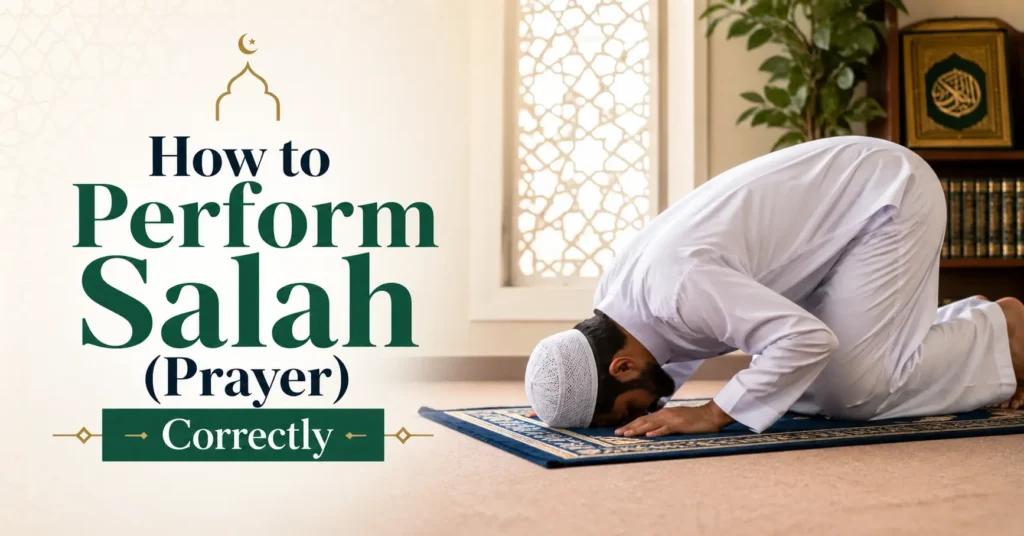
6. First Sujood (Prostration)
1. Go down into Sujood (prostration) slowly while saying “Allahu Akbar.”
2. Place your knees first, then hands, then nose and forehead on the ground. Keep your palms flat, fingers pointing toward the Qiblah, and elbows raised off the ground (especially for men).
3. Ensure your nose and forehead are firmly touching the ground, your toes are bent and pointing toward the Qiblah, and your thighs are slightly away from your stomach.
4. In this position, say at least three times:
“Subhana Rabbiyal A‘la”
Glory be to my Lord, the Most High
7. Jalsa (Sitting Between Two Sujood)
1. After completing the first prostration, rise calmly by lifting your head first, then your upper body.
2. Sit gently in a relaxed position:
- Place your left foot flat under your body.
- Keep your right foot upright, with the toes pointing toward the Qibla.
- Rest both hands on your thighs, close to your knees, with fingers naturally relaxed
3. Stay still and composed in this position and say:
“Rabbighfir li” (1–3 times)
“My Lord, forgive me.”
8. Second Sujood
Same as first sujood.
Again say:
“Subhana Rabbiyal A’la” (3 times or more)
9. Second Rak‘ah
1. After completing the second Sujood, rise up calmly to the standing position for the second rak‘ah.
2. Begin again by reciting Surah Al-Fatiha, followed by another short Surah or verses from the Qur’an.
3. Then continue the same sequence — Ruku (bowing) → Standing (Qawmah) → Sujood (prostration)
10. Tashahhud (Sitting After 2 Rak‘ahs)
1. Sit after the second rak‘ah in a calm and composed posture, similar to how you sit between the two sujoods.
2. Place your left hand on your left thigh and your right hand on your right thigh.
3. Then recite At-Tashahhud:
At-tahiyyaatu lillaahi was-salawaatu wat-tayyibaat,
Assalaamu ‘alaika ayyuhan-nabiyyu wa rahmatullaahi wa barakaatuh,
Assalaamu ‘alaynaa wa ‘alaa ‘ibaadillaahis-saaliheen,
Ashhadu allaa ilaaha illallaah, wa ashhadu anna Muhammadan ‘abduhuu wa rasooluh.
4. During the Shahadah, keep your right hand closed and raise your index finger slightly as you testify to the Oneness of Allah.
11. Durood Ibrahim
If you are in the final rak‘ah of your prayer, then after reciting At-Tashahhud, you should also recite Durood Ibrahim:
Allahumma salli ‘ala Muhammadin wa ‘ala aali Muhammad,
kamaa sallayta ‘ala Ibraaheem wa ‘ala aali Ibraaheem,
innaka Hameedun Majeed.
Wa baarik ‘ala Muhammadin wa ‘ala aali Muhammad,
kamaa baarakta ‘ala Ibraaheem wa ‘ala aali Ibraaheem,
innaka Hameedun Majeed.
This is an essential part of completing the prayer, where you send blessings upon the Prophet ﷺ before ending Salah.
12. Ending Salah (Tasleem)
To complete your Salah, perform the Tasleem (ending of prayer).
Turn your head to the right and say:
“Assalamu Alaikum wa Rahmatullah”
Then turn your head to the left and repeat:
“Assalamu Alaikum wa Rahmatullah”
With this, your prayer is completed.
Final Thoughts
Remember, Allah does not expect perfection—He loves effort and sincerity. Every prayer you perform is a step closer to Him. Every Sujood is a moment of peace. And every sincere effort is rewarded. Start today. Stay consistent. And let Salah become the most beautiful part of your daily life.
May Allah accept your prayers, guide you, and make Salah a source of peace and success for you. Ameen.