

For many Muslim families, balancing school and Quran learning for kids in Ontario can feel like trying to fit one more important piece into an already full day. There’s school, homework, sports, music lessons, family time, and then the little things that always seem to pop up. At first, it might seem like there’s simply not enough time. But with a thoughtful routine, it’s absolutely possible to help children grow academically and spiritually without making every afternoon feel rushed.
The goal isn’t to keep children busy from morning until bedtime. It’s to create a healthy rhythm that allows them to learn, rest, play, and spend time with family. When those pieces work together, children often feel more confident-and parents usually feel less stressed, too.
A mother in Mississauga once mentioned that evenings in her home felt chaotic. Her two children came home from school tired, homework stretched into dinner, and Quran lessons often felt like another task to complete. Instead of adding more structure, she actually simplified the routine. The children had thirty minutes to relax, eat a snack, and chat about their day before starting homework. Quran learning came later in the evening. Within a few weeks, the atmosphere at home felt noticeably calmer.
Stories like that aren’t unusual. Sometimes, the biggest improvement comes from making one small change rather than completely redesigning the family schedule.
This guide shares practical ideas that parents can adapt to their own routines. Every family is different, of course, but the principles remain the same: consistency, flexibility, and realistic expectations often matter more than trying to do everything perfectly.
Why Balancing School and Quran Learning Matters
Children don’t separate learning into neat little boxes the way adults sometimes do.
The patience they develop while studying the Quran can help them during school projects. The discipline they learn from completing homework can support their Quran studies. One area often strengthens the other, even if it isn’t obvious at first.
That’s why academic education and Islamic education shouldn’t be seen as competing priorities. They’re different parts of the same journey, helping children develop knowledge, character, confidence, and responsibility.
Parents occasionally worry that adding Quran lessons will reduce time for schoolwork. It’s an understandable concern. Yet many families discover the opposite. Once children follow a predictable routine, they often become better at managing their time because they know what comes next.
Think about it for a moment. Adults usually work more efficiently when their day has structure. Children aren’t much different.
Another important point is that balance doesn’t mean giving equal hours to everything. Some days school naturally requires more attention, especially during exams or major projects. Other days there’s more time for Quran revision or family learning. A flexible routine allows children to adapt without feeling that they’re falling behind.
The aim isn’t perfection.
It’s progress-and steady progress usually lasts longer.

The Benefits of a Balanced Education
Helping children succeed in both school and Quran learning isn’t only about academic achievement or memorization. It’s about supporting their overall development in a way that prepares them for everyday life.
Stronger Time Management Skills
Children don’t automatically know how to manage their time.
Like any other skill, they learn it through practice.
A simple daily routine teaches children how to move from one responsibility to another without feeling overwhelmed. School, homework, Quran study, free time, and family activities gradually become part of a familiar rhythm.
One father laughed while describing the difference a family calendar made. Before using it, his son asked, “What am I supposed to do now?” almost every evening. A month later, he was checking the schedule himself and getting ready for his online lesson without being reminded.
It wasn’t magic.
It was simply consistency.
Building Character Alongside Academic Success
Good grades certainly matter.
But qualities like honesty, kindness, patience, gratitude, and respect matter just as much.
Online Quran learning gives parents regular opportunities to discuss these values and connect them to everyday situations. A conversation about honesty can continue on the drive to school. A lesson about kindness might remind a child to include someone sitting alone at lunch.
Those moments often become the lessons children remember longest.
After all, it’s one thing to learn about compassion.
It’s another thing entirely to practise it on an ordinary Tuesday afternoon.
Developing Discipline Through Daily Habits
Children benefit from routines because routines reduce uncertainty.
When homework and Quran study happen at roughly the same time each day, children spend less energy deciding when to begin. They simply know it’s part of the evening.
That doesn’t mean every day looks identical.
Family visits happen. Hockey practice runs late. Winter weather delays everyone (Ontario parents know that feeling well).
The routine can bend a little without breaking.
That’s an important lesson in itself.
Supporting Emotional and Spiritual Well-Being
Today’s children grow up in a fast-moving world.
Assignments, social activities, extracurricular commitments, and digital distractions compete for their attention almost constantly. It’s no surprise that some children feel mentally tired by the end of the day.
A balanced routine creates small opportunities to slow down.
Reading a few verses together, reflecting on their meaning, or simply talking about what went well that day gives children a chance to pause. Those conversations don’t have to be long. Sometimes five quiet minutes become the most meaningful part of the evening.
One parent shared that bedtime had become her favourite part of the day. Not because everything was perfect-it definitely wasn’t-but because those few minutes of conversation helped everyone reconnect after a busy schedule.
And perhaps that’s the biggest benefit of all.
Balancing school and Quran learning isn’t just about fitting another lesson into the calendar. It’s about creating a home where education, faith, family, and everyday life naturally support one another.
Common Challenges Ontario Parents Face
Every family has its own rhythm, and that’s exactly why there’s no universal schedule that works for everyone. What feels manageable for one household might feel overwhelming for another. The encouraging part is that most of the challenges parents face aren’t permanent-they’re simply problems that need practical solutions.
If you’ve ever looked at the clock and wondered, “How did it get this late already?” you’re definitely not alone. Most Ontario parents have had evenings where dinner is still cooking, homework isn’t finished, and Quran class is starting in twenty minutes. It happens.
The goal isn’t to eliminate busy days. It’s to learn how to navigate them without turning every evening into a race against the clock.
Busy School Schedules
School naturally takes up a large part of a child’s day.
By the time children return home, they’ve already spent hours learning, following instructions, and interacting with classmates. They’re often mentally tired before homework even begins.
That’s why expecting them to jump straight into another lesson isn’t always realistic.
A short break can make a remarkable difference.
One family in Brampton noticed their son became frustrated during Quran lessons immediately after school. They changed just one thing. Instead of opening his laptop right away, he spent twenty minutes riding his bicycle around the neighbourhood and eating a healthy snack.
The lesson itself didn’t change.
His attitude did.
Sometimes children don’t need less learning-they simply need a little breathing room first.
Homework and Exam Periods
Every school year has busy seasons.
Projects pile up. Tests arrive one after another. Teachers assign extra revision, and suddenly evenings feel much shorter than they did a month earlier.
During these weeks, some parents consider pausing Quran lessons completely.
Often, that isn’t necessary.
Instead, adjust expectations for a short period. A fifteen-minute review session may be enough to maintain consistency until exams are over.
Think of it like exercising.
Missing one workout isn’t a problem. Completely stopping for weeks makes it much harder to begin again.
The same principle often applies to learning.
Sports and Extracurricular Activities
Ontario offers children plenty of opportunities outside the classroom.
Hockey practices, soccer games, swimming lessons, martial arts, dance classes, music lessons… the list can become surprisingly long.
These activities are valuable. They help children stay active, build friendships, and develop confidence.
But they also require time.
Rather than trying to squeeze everything into every single day, look at the week as a whole.
Perhaps Tuesday and Thursday are dedicated to sports, while Monday, Wednesday, and Saturday become Quran learning days.
Families often find that weekly balance works much better than expecting every day to look identical.
Screen Time and Digital Distractions
Technology has become part of everyday life.
Children use laptops for school assignments, tablets for learning, and phones for staying connected with friends. Then there are video games, streaming services, and social media competing for attention.
It’s easy for an intended ten-minute break to quietly become an hour.
Sound familiar?
Instead of making screens the enemy, establish predictable boundaries.
Homework first.
Quran lesson next.
Entertainment afterwards.
One father joked that his biggest parenting challenge wasn’t homework-it was convincing his children that “five more minutes” actually meant five minutes.
His family eventually created a charging station near the kitchen. During homework and Quran study, everyone’s devices stayed there-including the parents’ phones.
Interestingly, the children stopped complaining once they saw adults following the same rule.
Children notice fairness.
Practical Tips for Balancing School and Quran Learning for Kids in Ontario
Finding balance doesn’t require an elaborate timetable or military-level planning.
In fact, the routines that last are usually the simplest ones.
Children don’t need every minute scheduled. They need a predictable rhythm that leaves room for learning, family, rest, and, just as importantly, being kids.
Create a Weekly Family Schedule
A visible family schedule removes a lot of uncertainty.
Whether it’s a paper calendar on the fridge or a digital planner shared with everyone, seeing the week’s activities helps children understand what’s coming next.
Include school hours, homework, Quran lessons, extracurricular activities, family meals, and free time.
Don’t forget to leave a little empty space.
Life has a habit of filling it anyway.
One mother laughed as she looked at her carefully colour-coded planner.
“It never goes exactly according to plan,” she admitted.
“But at least everyone knows where we’re trying to go.”
That’s really the purpose of a schedule.
Not perfection.
Direction.
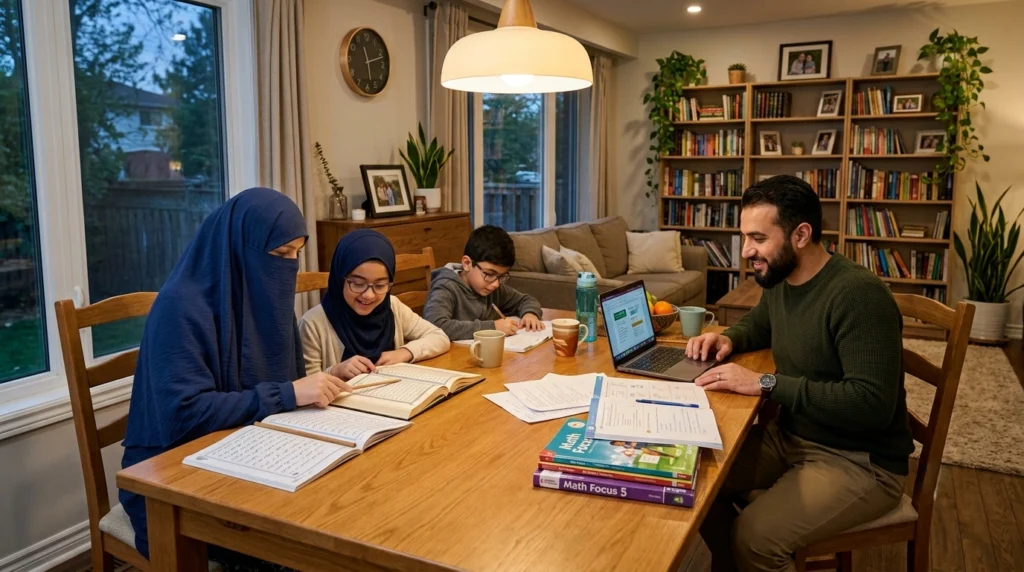
Choose Flexible Online Quran Classes
Many families appreciate online Quran classes for kids because they remove one of the biggest challenges—travel.
Instead of driving across town after school, children can learn from the comfort of home. That extra time often becomes family time, homework time, or simply time to relax.
Flexibility is another advantage.
Evening lessons.
Weekend sessions.
Adjusted schedules during school holidays.
Having options makes it easier to maintain consistency throughout the year.
Set Small, Achievable Learning Goals
Big goals can feel exciting.
Small goals get completed.
Rather than expecting children to cover a large amount of material at once, divide learning into manageable steps.
Maybe this week’s goal is improving pronunciation.
Next week might focus on understanding the meaning of a short passage.
Those steady improvements build confidence much faster than unrealistic expectations.
Children enjoy feeling successful.
And honestly, adults do too.
Establish a Consistent Daily Routine
Children usually thrive when they know what comes next.
Perhaps homework begins after a snack.
Quran study follows homework.
Dinner comes afterward.
The exact order doesn’t matter nearly as much as maintaining consistency.
Of course, routines will occasionally change.
Winter storms happen.
School events run late.
Family visits come up unexpectedly.
That’s life.
A flexible routine isn’t a failed routine. It’s simply one that adapts without losing its overall direction.
Prioritize Quality Over Study Hours
It’s easy to assume that longer lessons automatically produce better results.
They usually don’t.
A focused twenty-minute Quran lesson often achieves far more than an hour spent battling tiredness and distractions.
Watch your child’s energy level.
If they’re engaged, keep going.
If they’re exhausted, it may be better to finish on a positive note and continue tomorrow.
Children are much more likely to return with enthusiasm when learning ends with a sense of accomplishment instead of frustration.
Why Online Quran Classes Work Well for Ontario Families
Family life rarely follows the same schedule every day.
One week is filled with school projects. The next brings hockey practice, piano lessons, or a family gathering. That’s why many parents look for learning options that fit around life instead of asking life to fit around them.
For many families, online Quran classes for kids have become a practical solution. They offer flexibility, consistency, and the chance to learn from home without adding extra travel to an already busy evening.
The biggest benefit isn’t simply convenience.
It’s peace of mind.
Parents spend less time driving, children spend less time rushing, and everyone gains a little breathing space. Sometimes that extra half hour makes the entire evening feel calmer.
Evening and Weekend Availability
Every child follows a different routine.
Some finish homework quickly. Others need extra time after school. Some children play sports several evenings a week, while others have music lessons or language classes.
A fixed timetable doesn’t always fit those different lifestyles.
Flexible Quran classes make it easier to choose lesson times that work for the family instead of constantly rearranging everything else.
One father from Ottawa shared that his daughter’s swimming practice used to clash with Quran lessons every Thursday. Rather than giving up one activity, they simply moved the lesson to Saturday morning.
“It sounds like a small change,” he said, “but suddenly nobody felt rushed anymore.”
Sometimes the best solution really is that simple.
One-to-One Personalized Learning
No two children learn in exactly the same way.
Some enjoy reading aloud confidently. Others prefer listening first before trying on their own. Some ask dozens of questions during every lesson (and that’s usually a good sign). Others quietly absorb information before speaking.
Personalized learning gives tutors the freedom to teach according to each child’s pace.
If pronunciation needs extra practice, they can slow down.
If memorization is progressing well, they can gently introduce new material without making lessons feel overwhelming.
Parents often notice another benefit, too.
Children who receive individual attention usually become more willing to participate because they don’t worry about keeping up with a larger group.
Learning becomes a conversation instead of a race.
Learning from the Comfort of Home
Ontario winters have a way of reminding everyone how valuable staying home can be.
Snowfall, icy roads, and heavy traffic aren’t unusual during parts of the year. Travelling across town for an evening lesson isn’t always practical.
Learning from home removes that challenge.
Children can finish school, enjoy some time with family, and join their lesson from a familiar, comfortable space.
One mother laughed while remembering how stressful winter evenings used to be.
“We spent more time finding mittens than actually driving.”
Now, her children simply open their laptop a few minutes before class begins.
Less rushing.
Less stress.
More time together.
Those are benefits parents appreciate just as much as the lessons themselves.
Flexible Scheduling During Exams and Holidays
School schedules naturally change throughout the year.
Exam weeks require extra revision. Holidays bring family visits and travel plans. Summer often looks completely different from autumn.
That’s perfectly normal.
Flexible learning allows families to adjust without feeling they’ve fallen behind.
Some weeks might include shorter lessons.
Other weeks offer more time for revision or memorization.
The important thing is staying connected to learning, even if the schedule changes temporarily.
Consistency doesn’t always mean doing exactly the same thing every week.
Sometimes it simply means returning to your routine after life becomes busy again.
Helping Children Stay Motivated
Most children begin learning with excitement.
Keeping that excitement alive over months-or even years-is where parents make the biggest difference.
Motivation doesn’t usually appear overnight.
It grows through encouragement, positive experiences, and the feeling that progress is possible.
Celebrate Progress Instead of Perfection
Children notice what adults pay attention to.
If every conversation focuses only on mistakes, learning can gradually become discouraging.
Instead, celebrate effort.
Praise consistency.
Notice improvement.
One family created a simple tradition at dinner every Friday evening.
Everyone shared something they were proud of from the week.
Sometimes it was finishing homework early.
Sometimes it was learning a new surah.
Sometimes it was simply remembering to help a younger sibling without being asked.
Those conversations quietly built confidence because success wasn’t measured only by big achievements.
Small steps mattered, too.
Encourage Without Creating Pressure
Parents naturally want their children to succeed.
The challenge is encouraging them without making every lesson feel like a performance.
When children struggle, curiosity often works better than criticism.
Instead of asking,
“Why haven’t you finished this yet?”
try asking,
“Which part feels difficult?”
That one question changes the conversation.
Children become more willing to explain their challenges, and parents can offer support rather than correction.
It’s a small shift in language, but it often creates a much calmer learning environment.
Build Positive Learning Habits
Habits reduce decision-making.
When Quran learning happens at roughly the same time each week, children gradually stop asking whether they should study.
They simply know it’s part of the routine.
Pairing Quran lessons with existing habits can also help.
For example:
- Homework first.
- Short break.
- Quran lesson.
- Family dinner.
- Free time before bed.
Simple routines often last longer than complicated ones.
Make Quran Learning Part of Family Life
Children become more engaged when parents show genuine interest.
You don’t have to become the teacher.
Just ask questions.
Listen when your child recites.
Talk about what they learned.
A parent once mentioned that after every lesson, he asked his son to explain one new thing he had learned that day.
The explanation usually lasted only a minute or two.
But over time, those conversations became something they both looked forward to.
Children remember moments like these.
Not because they’re dramatic.
Because they’re shared.
Sample Daily Routine for Ontario Students
Every family follows a different schedule, so think of this as a starting point rather than a strict timetable.
The goal isn’t to fill every minute.
It’s to create a balanced day that includes learning, rest, family time, and play.
Weekday Example
| Time | Activity |
|---|---|
| 7:00 AM | Wake up and prepare for school |
| 8:30 AM – 3:30 PM | School |
| 3:45 PM | Healthy snack and relax |
| 4:15 PM | Homework and assignments |
| 5:15 PM | Outdoor play or physical activity |
| 6:00 PM | Online Quran lesson or revision |
| 6:45 PM | Family dinner |
| 7:30 PM | Reading, family time, or quiet activities |
| 8:30 PM | Prepare for bed |
The schedule doesn’t need to be followed perfectly every day.
Some evenings will look different.
That’s okay.
A routine should support family life-not control it.
Weekend Example
Weekends usually provide a little more flexibility.
Many Ontario families choose Saturday mornings for longer Quran lessons because children are well rested and there’s less pressure to hurry.
The afternoon can then be used for sports, visiting relatives, community activities, or simply spending time together.
Sunday often works well as a review day.
Rather than introducing lots of new material, children revisit previous lessons, practise pronunciation, or discuss meanings with their parents.
It’s a gentle way to prepare for the week ahead without making Sunday feel like another school day.
Mistakes Parents Should Avoid
Every parent wants to make the right decisions for their child. Even so, there are moments when good intentions lead to routines that create unnecessary pressure. That’s perfectly normal.
The encouraging part is that children are remarkably adaptable. A small change in approach can completely transform how they feel about learning.
The aim isn’t to create a perfect schedule.
It’s to build one that your family can actually maintain.
Overscheduling Children
It’s easy to believe that every free hour should be productive.
School.
Homework.
Sports.
Music lessons.
Quran classes.
Tutoring.
Before long, a child’s calendar can look busier than an adult’s.
Children need unstructured time, too.
A little time to ride a bike, draw, read for fun, or simply do nothing for a while isn’t wasted time. Those quiet moments help them recharge.
One Ontario parent admitted she didn’t realize how exhausted her daughter had become until she fell asleep in the car on the way to a weekend activity.
That was a wake-up call.
The family decided to reduce just one extracurricular activity, and within a few weeks their evenings felt calmer. Interestingly, their daughter became more focused during both homework and Quran lessons.
Sometimes doing less actually helps children achieve more.
Comparing Children
Every child follows a different path.
Some memorize quickly.
Others ask lots of questions before they feel confident moving forward.
Some enjoy reading aloud.
Others quietly absorb information before speaking.
All of those learning styles are perfectly normal.
Comparisons, however, rarely produce positive results.
Saying things like, “Your cousin finished this already,” or “Your brother never struggles with this,” may seem motivating, but children often hear something very different.
They hear that they’re not measuring up.
A better approach is to compare today’s progress with last month’s progress.
Growth is personal.
That’s what deserves celebration.
Ignoring Rest and Play
Children aren’t machines.
After spending six or seven hours at school, it’s natural for them to feel mentally tired.
Parents sometimes worry that taking a break will reduce productivity.
Ironically, the opposite is often true.
A short walk outside.
A healthy snack.
Ten or fifteen minutes of free play.
These simple pauses help children return to learning with fresh energy.
Think about your own workday.
Most adults don’t perform at their best without occasional breaks, and children are no different.
Expecting Immediate Results
Learning takes time.
Whether it’s mathematics, reading, learning a new language, or studying the Quran, meaningful progress usually happens gradually.
There will be weeks when children seem to improve quickly.
Then there will be weeks when it feels as though nothing is changing.
That’s part of the process.
One parent shared that her son struggled with pronunciation for several weeks.
She worried he wasn’t making progress at all.
Then one evening, almost unexpectedly, he recited an entire passage with confidence.
“It was like everything finally clicked,” she said.
Sometimes growth happens quietly before it becomes visible.
Patience really does matter.
Making Learning Feel Like a Chore
Children are naturally curious.
The challenge is protecting that curiosity.
If every lesson revolves around correction, deadlines, or pressure, enthusiasm can slowly disappear.
Instead, create positive experiences around learning.
Ask what your child found interesting today.
Discuss the meaning of a verse together.
Celebrate milestones-even small ones
One father began asking his daughter one simple question after every lesson:
“What’s one thing you’ll remember from today?”
Some days she answered immediately.
Other days she thought for a minute before smiling.
Those conversations became more valuable than either of them expected because learning continued long after the lesson had ended.
Frequently Asked Questions
How can parents balance school and Quran learning without overwhelming their children?
Start with a routine that’s realistic rather than ambitious.
Short, consistent Quran sessions usually work better than occasional long lessons. Make sure your child also has time for homework, rest, family activities, and play. Balance is much easier to maintain when the schedule leaves room to breathe.
What’s the best time for Quran lessons after school?
Every child is different, so there’s no single “perfect” time.
Many Ontario families find that children concentrate better after having a snack, relaxing for a short while, and finishing homework. Others prefer evening or weekend lessons. The best schedule is one your family can follow consistently.
Are online Quran classes suitable for busy students?
Yes, they’re often an excellent option.
Online lessons reduce travel time and provide greater flexibility around school, sports, and other activities. For many families, learning from home makes it much easier to stay consistent throughout the year.
How many Quran lessons should children have each week?
That depends on your child’s age, learning goals, and overall routine.
Many families choose three to five lessons each week, while others prefer fewer sessions with additional practice at home. The focus should be on steady progress rather than completing as many lessons as possible.
What should parents do if their child loses motivation?
Stay patient and keep the conversation open.
Ask your child what feels difficult instead of assuming they simply don’t want to learn. Sometimes a small schedule adjustment, a supportive teacher, or celebrating small achievements is enough to rebuild confidence and enthusiasm.
Conclusion
Balancing school and Quran learning for kids in Ontario isn’t about creating the perfect timetable. Family life is rarely that predictable.
Some weeks will run smoothly.
Others won’t.
That’s completely normal.
What matters most is building a routine that’s consistent enough to support learning and flexible enough to adapt when life becomes busy. Children benefit far more from steady habits than from unrealistic expectations.
Remember, success isn’t measured only by report cards or the number of lessons completed. It’s also reflected in a child’s character, confidence, kindness, responsibility, and willingness to keep learning.
If you’re just beginning this journey, don’t try to change everything at once.
Choose one small improvement this week.
Perhaps it’s creating a simple evening routine.
Maybe it’s setting aside twenty focused minutes for Quran study.
Or perhaps it’s having a conversation with your child about how they’re feeling and what would help them succeed.
Small steps often lead to lasting habits.
With patience, encouragement, and a balanced approach, your child can thrive in both school and Quran learning-one day, one lesson, and one meaningful moment at a time.