
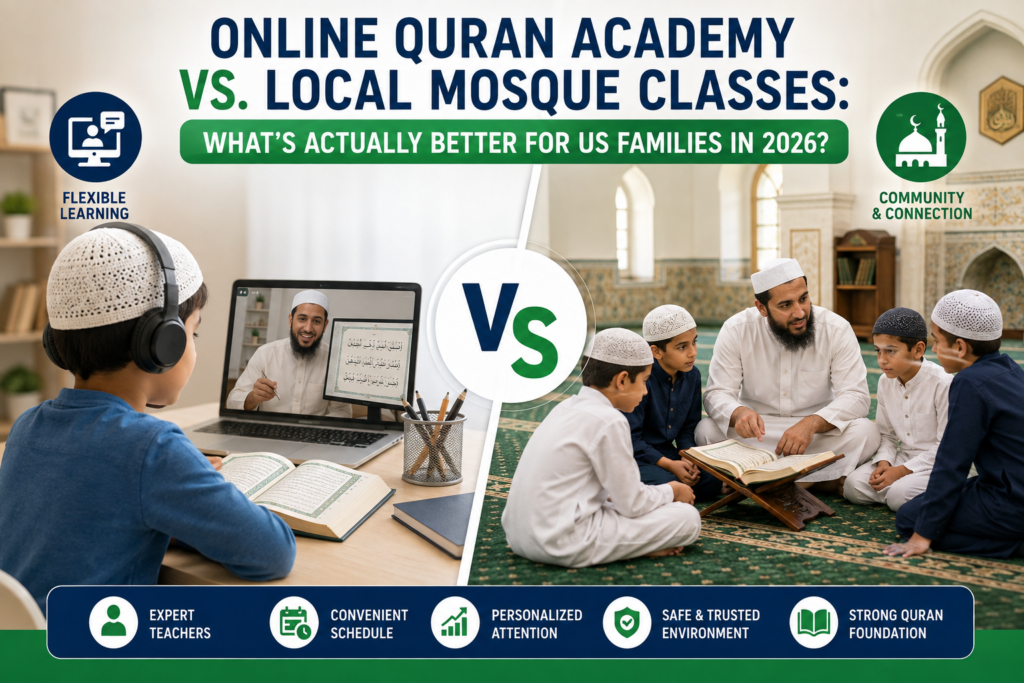
Online Quran academy vs local mosque classes is not a simple choice between modern and traditional learning. An online academy may offer flexible, personalized instruction from home. Local mosque classes can provide face-to-face teaching and community connection. The better option depends on teacher quality, class size, schedule, learning goals, and your child’s needs.
For many Muslim parents in the United States, choosing Quran classes sounds simple until real life gets involved.
School ends in the afternoon. Homework follows. Then there may be soccer, tutoring, family responsibilities, or a long drive to the nearest suitable Islamic program.
Parents also want more than convenience. They want their child to read the Qur’an correctly, develop proper Tajweed, and enjoy learning.
That creates an important question:
Should your child learn through an online academy or attend classes at a local mosque?
The honest answer is that neither format wins for every family.
A strong mosque program can be excellent. A strong online program can be excellent too. What matters most is what happens during the lesson.
Is the teacher qualified? Does your child receive enough attention? Is progress tracked? Can your family maintain the schedule?
This guide helps you answer those questions before making a commitment.
Who Is This Comparison For?
This guide is useful if you are:
- Comparing Quran programs for your child
- Considering moving from mosque classes to online learning
- Unhappy with your child’s current class size
- Living far from a suitable mosque program
- Looking for one-to-one Quran instruction
- Trying to fit Quran learning around an American school schedule
- Comparing group classes with private lessons
- Looking for Tajweed or Hifz instruction
- Considering a combination of online and mosque learning
It can also help adults who are deciding how they want to study the Qur’an.
One important point comes first.
Do not leave a good mosque program simply because it is a mosque program.
If the teacher is qualified, your child is progressing, and the schedule works, staying may be the best decision.
The goal is not to move every family online.
The goal is to find a learning environment your family can trust and maintain.
Why Choosing the Right Quran Learning Format Matters
The learning format affects more than where your child’s lesson takes place.
The emotional side
Children remember how learning feels.
A child who receives constant criticism may begin to associate recitation with embarrassment. Another child may become excited when a teacher notices small improvements.
Confidence matters.
A student who feels comfortable asking questions is more likely to keep practicing. That matters when learning correct pronunciation, Tajweed rules, or Quran memorization.
Parents also carry an emotional burden.
You want to know that the time your child spends learning is actually helping.
The practical side
American family schedules can make consistency difficult.
Your child may have:
- School during the week
- Homework every afternoon
- Sports and extracurricular activities
- Weekend commitments
- Family responsibilities
- Long travel times
- A different schedule from siblings
A class can look excellent on paper but fail in practice.
If your child regularly misses lessons, progress can slow.
Consistency is one of the most overlooked factors in Quran education.
A manageable program that your child attends consistently can outperform an excellent program that your family cannot maintain.
How Online Quran Learning Works
Online programs vary, but a structured academy usually follows a clear process.
1. The student receives an assessment
The teacher identifies the student’s current level.
A beginner may start with Arabic letters and Noorani Qaida. Another student may already be reading the Qur’an and need Tajweed correction.
2. The family chooses a suitable schedule
The family agrees on lesson times that fit their routine.
This can help parents balance school, work, sports, and other commitments.
3. The teacher delivers a live lesson
The student joins a live online classroom.
The technology itself does not create good teaching.
A useful lesson should include listening, reading, correction, explanation, and practice.
4. The teacher corrects recitation
The instructor listens carefully to the student’s reading.
They can identify pronunciation problems and Tajweed mistakes as they occur.
5. The student practices between lessons
The teacher assigns material for review.
Short, regular practice can be more useful than cramming before the next class.
6. Progress is reviewed
Parents should know whether their child is improving.
A structured program may track attendance, reading ability, Tajweed development, memorization, or other agreed goals.
How Local Mosque Quran Classes Work
Mosque programs differ considerably.
Some offer small classes with experienced teachers. Others use larger groups with a shared curriculum.
A typical program may work like this:
- The family registers with the mosque or Islamic school.
- The child is assessed or placed into a level.
- Classes meet at scheduled times.
- One teacher works with several students.
- Students read, memorize, or study together.
- The teacher provides corrections.
- Progress may be checked through tests or regular observation.
The biggest variable is often class size.
A small group can provide personal interaction and community. A crowded class may leave less time for individual correction.
That means the words “mosque class” do not tell you enough.
Ask about the actual classroom.
What Online Quran Academies Can Do Well
When properly structured, online learning can solve several problems for US families.
Flexible scheduling
Families can often choose from more lesson times.
That can help when school, work, or extracurricular schedules change.
Individual attention
One-to-one instruction allows the teacher to focus on one student’s recitation.
This can be especially useful for detailed Tajweed correction.
Wider teacher choice
Families are not limited to teachers who live nearby.
This can help when parents want a particular teaching style, experience, language, or teacher gender.
No commuting
The lesson takes place at home.
For families far from a suitable Islamic center, this can make regular attendance easier.
Personalized pace
Students can spend more time on areas they find difficult.
A faster learner can also move forward without waiting for an entire group.
Easier parent visibility
Depending on the academy, parents may have direct access to teacher feedback.
They can also understand what their child should practice between lessons.
What Local Mosque Classes Can Do Better
The advantages of in-person learning deserve equal attention.
Community connection
A mosque is more than a classroom.
Children can meet other Muslim children and become comfortable in the masjid environment.
Peer interaction
Some children learn well by watching and interacting with classmates.
Group activities can also create a sense of belonging.
A dedicated learning environment
Some children focus better when they leave home for class.
A physical learning environment can separate study time from toys, siblings, and household distractions.
Less screen exposure
The lesson does not require a computer or tablet.
This can matter to parents who already manage significant daily device use.
Face-to-face interaction
Some parents and children simply prefer learning with a teacher in the same room.
That preference should not be dismissed.
Connection with local Islamic life
Regular mosque attendance can expose children to other programs and community activities.
That broader experience can support a child’s sense of belonging.
Online Quran Academy vs. Local Mosque Classes: Side-by-Side
| Factor | Online Quran Academy | Local Mosque Classes |
|---|---|---|
| Schedule | Usually more flexible | Usually fixed |
| Class size | Often one-to-one or small | Often group-based |
| Teacher choice | Wider selection | Depends on local availability |
| Travel | None | Required |
| Individual attention | Often high in private lessons | Depends on class size |
| Community | More limited | Usually stronger |
| Peer interaction | Limited | Stronger |
| Screen exposure | Required | Minimal |
| Learning pace | Often personalized | Often follows group pace |
| Masjid environment | Not part of the lesson | Built into the experience |
| Best fit | Flexible, personalized learning | Community and group learning |
This table is not a scorecard.
For some families, flexibility will matter most. For others, community connection will matter more.
The right question is:
Which factors matter most for your child?
What If Your Child Needs Tajweed or Hifz?
The learning goal can change which format makes sense.
For basic Quran reading, both group and private classes can work well.
For Tajweed, frequent individual correction can be valuable. The teacher needs to hear how the student applies rules during actual recitation.
For Hifz, consistency becomes especially important.
Students need a clear memorization plan, regular revision, and careful monitoring. Previously memorized passages also need regular review.
A private online teacher may provide close individual monitoring.
A mosque may offer an excellent Hifz environment if it has an experienced instructor and structured program.
The teacher and curriculum matter more than the building or screen.
What About the Downsides? Honest Answers for Parents
Choosing an online program can raise legitimate concerns.
Those concerns deserve direct answers.
“Won’t this add more screen time?”
That’s a reasonable concern.
The answer is not to pretend screen exposure has no downside.
A focused Quran lesson is different from recreational device use. Parents can also keep practice offline.
Children can review memorization, read from a physical Qur’an, and practice pronunciation away from the screen.
“My child won’t concentrate at home.”
Some children genuinely struggle with online learning.
A few changes can help:
- Use a quiet learning space
- Keep toys away during lessons
- Use headphones when suitable
- Maintain a consistent lesson location
- Choose shorter sessions for younger children
- Select a teacher experienced with children
- Provide parent support when needed
If your child still cannot focus, an in-person program may be a better fit.
Convenience should not override your child’s needs.
“Isn’t in-person teaching automatically better?”
No.
Being in the same room does not guarantee individual attention.
Consider two situations.
Program A: 18 students share one teacher.
Program B: One student has a qualified teacher listening closely to every recitation.
The second student may receive more direct correction.
But the opposite can also happen.
A small mosque class with an excellent teacher may outperform a poorly managed online lesson.
“How can I trust an online teacher?”
This is one of the most important questions parents should ask.
Do not choose a teacher based only on a friendly introduction or attractive website.
Check qualifications, teaching experience, curriculum, supervision, and progress reporting.
A trustworthy academy should explain how teachers are selected and how children’s classes are managed.
How to Evaluate the Quality of Any Quran Program
Whether you choose online or in-person learning, use the same basic checklist.
1. Teacher qualifications
Ask:
- What has the teacher studied?
- Do they have Quran or Tajweed qualifications?
- Do they have an Ijazah where appropriate?
- How much experience do they have with children?
- Is the teacher’s background clearly explained?
Qualifications do not guarantee excellent teaching.
They do give parents an important starting point.
2. Safety measures
For children, ask how the organization handles safeguarding.
Understand:
- Who teaches your child
- How communication works
- Whether parents can observe or remain nearby
- How concerns are reported
- What policies apply to children’s classes
Do not accept vague answers.
3. Supervision clarity
You should know who is responsible for the lesson.
For online classes, ask whether a parent should remain nearby for younger children.
For mosque classes, ask how children are supervised before and after lessons.
Clear responsibility protects both children and teachers.
4. Curriculum structure
A good program should know where a student is going.
Beginners may start with Noorani Qaida, letter recognition, pronunciation, and basic reading.
Students can then progress toward fluent recitation, Tajweed, memorization, Hifz, or Islamic studies.
The exact path should match the student’s ability.
5. Progress tracking
Ask how improvement is measured.
Useful indicators can include:
- Attendance
- Recitation accuracy
- Tajweed development
- Memorization progress
- Lesson completion
- Regular assessments
- Teacher feedback
Parents should not have to guess whether their child is improving.
Which Option Is Actually Better for Your Family?
The answer becomes clearer when you start with your family’s situation.
Online learning may be the better fit if:
- Your child’s schedule changes often.
- Your family has limited commuting time.
- The nearest suitable mosque program is far away.
- Local classes have large groups.
- Your child needs individual correction.
- You need access to a specific teacher.
- Your child needs a personalized learning pace.
- Your family needs unusual lesson times.
A mosque program may be the better fit if:
- Your local program has qualified teachers.
- The class size allows meaningful attention.
- Your child enjoys group learning.
- Community interaction is a major priority.
- The schedule fits comfortably.
- Your child focuses better outside the home.
- Regular mosque attendance matters to your family.
A hybrid approach may work if:
- Your child needs private Tajweed or Hifz instruction.
- You also want regular mosque involvement.
- Your family values both personalization and community.
- The local program provides something online learning cannot replace.
- The combined schedule remains manageable.
You do not have to treat this as a permanent either-or decision.
The right arrangement can change as your child grows.
Quality Beats Format
Here is the principle that should guide the final decision:
A qualified teacher, suitable curriculum, consistent attendance, and strong communication matter more than whether a lesson happens online or inside a mosque.
This matters because parents often compare labels instead of learning conditions.
“Online” does not tell you whether the teacher is good.
“Mosque” does not tell you whether the class is small.
“Private” does not tell you whether the curriculum is structured.
“In-person” does not guarantee progress.
Before enrolling, ask what your child will actually experience during a normal lesson.
Will the teacher hear them recite?
Will mistakes be corrected?
Will the child get enough practice?
Will someone notice if progress slows?
Will parents know what to practice at home?
Those answers reveal more than the class format.
Common Mistakes to Avoid
Avoid these mistakes when comparing Quran programs.
1. Choosing only by price
The cheapest option is not always the best value.
Consider teacher attention, lesson quality, progress tracking, and consistency.
2. Assuming online automatically means better
Flexibility helps, but it cannot compensate for poor teaching.
3. Assuming mosque classes automatically mean better
A masjid environment is valuable, but classroom quality still matters.
4. Ignoring class size
Ask how many students share the teacher’s attention.
5. Skipping teacher qualification checks
Know who will teach your child.
6. Ignoring your child’s learning style
Some children thrive independently. Others benefit from group interaction.
7. Choosing an unrealistic schedule
A perfect schedule that your family cannot follow is not a good schedule.
8. Focusing only on memorization
Memorizing more pages does not automatically mean stronger recitation.
Reading foundations and Tajweed matter too.
9. Failing to ask how progress is measured
If there is no clear answer, investigate further.
10. Committing before testing the fit
A trial lesson can reveal things a website cannot.
Frequently Asked Questions
Are online Quran classes better than local mosque classes?
Not for every family. Online learning can work well when flexibility and individual attention matter most. Mosque classes can be stronger for community and group interaction. Compare the teacher, class size, curriculum, and schedule before choosing.
Are online Quran classes effective for children?
Yes, they can be effective when lessons include qualified teaching, active recitation, regular correction, structured goals, and consistent practice. Younger children may need extra parent support during online lessons.
How much do Quran classes cost in the USA?
Costs vary by teacher, class format, lesson frequency, and program structure. Private instruction often differs from group learning. Compare the teaching time and service quality rather than looking only at the monthly price.
Are online Quran classes safe for kids?
They can be, but parents should evaluate teacher selection, safeguarding practices, supervision expectations, and communication policies. Ask specific questions before enrolling your child.
Is one-to-one or group Quran learning better for children?
It depends on the child. One-to-one lessons can offer more individualized correction and pacing. Group classes can provide peer interaction and community. Age, personality, and learning goals should guide the decision.
Can my child attend both mosque and online Quran classes?
Yes, when the combined schedule remains manageable. A hybrid approach can provide personalized instruction while keeping the child connected to the local Muslim community. Avoid overloading the child with too many lessons.
Final Verdict: Which Is Better for US Families in 2026?
The online Quran academy vs local mosque classes decision does not have one universal winner.
A strong mosque program may be the right choice when your child benefits from community, group interaction, and a masjid environment.
A quality online academy may be better when your family needs flexible scheduling, individualized instruction, or access to teachers beyond your local area.
A hybrid approach can also make sense.
The most important question is not “Which format is better?”
It is:
“Which option gives my child qualified teaching, enough attention, consistent practice, and a positive relationship with the Qur’an?”
That is the decision worth making.
If you are considering online learning, you do not need to commit blindly. A trial gives your family a chance to evaluate the teacher, lesson structure, communication, and your child’s comfort before making a longer commitment.
Book a Free 3-Day Trial and see whether one-to-one online Quran learning fits your child’s needs before you decide.