
Salah (prayer) is not just an act of worship; it is a beautiful and direct connection with Allah. It is the moment when a Muslim stands humbly before the Creator of the entire universe and speaks to Him without any barrier. Salah is so important in Islam that it will be the very first deed we will be questioned about on the Day of Judgment.
However, many people, unknowingly, make mistakes during Salah. Some mistakes are minor, while others can affect the beauty, focus, or even the validity of the prayer itself. This is why learning and correcting these mistakes is extremely important.
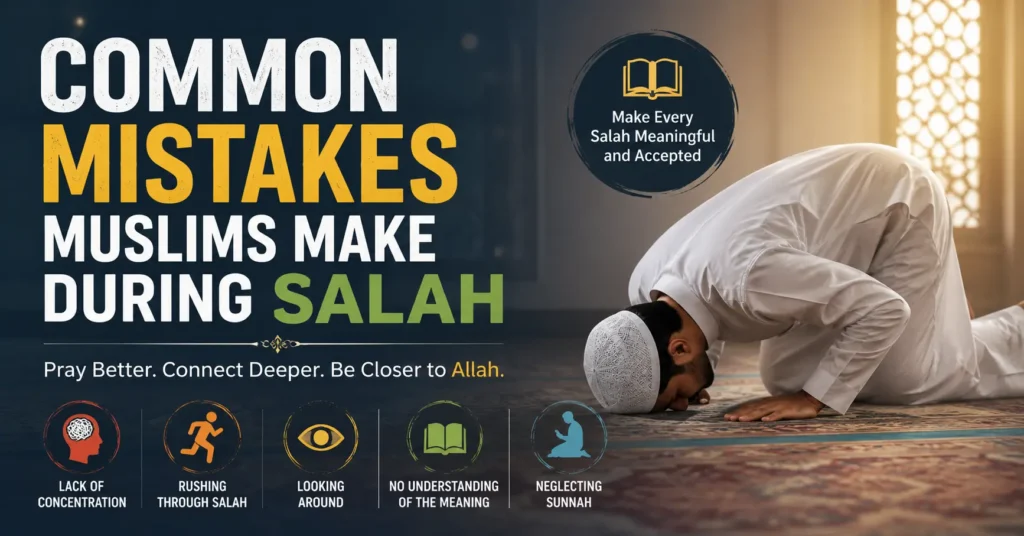
1. Praying Without Proper Concentration (Khushu)
One of the biggest mistakes people make in Salah is praying without proper concentration and focus. Their bodies may be standing in prayer, but their minds are busy with work, business, studies, or other worldly matters. Instead of fully connecting with Allah, they become lost in their thoughts and distractions.
2. Rushing Through Salah
Another very common mistake people make during Salah is praying too fast. Many people perform prayer as if it is just a daily routine that needs to be completed quickly, rather than a beautiful connection with Allah. They rush through the recitation and movements so quickly that they barely perform the positions properly or pause with calmness and sincerity.
Salah should never feel like a race. Every posture in prayer carries meaning, humility, and submission before Allah. When a person rushes through Salah, they miss the spiritual peace and connection that prayer is meant to bring.
3. Looking Around During Salah
Another common mistake many people make during Salah is looking around repeatedly while praying. Constantly turning the head or shifting the eyes here and there weakens concentration and distracts the heart from the prayer. Instead of focusing on Allah, the mind becomes busy with the surroundings and unnecessary distractions.
4. Praying Without Understanding the Meaning
Another common mistake many people make—especially non-Arabic speakers—is memorizing the Arabic words and phrases of Salah without truly understanding their meaning. As a result, they recite the prayer mechanically, without reflecting on what they are actually saying to Allah.
When the meaning is not understood, the heart often remains disconnected from the prayer, even if the tongue is busy in recitation. But Salah is not just about repeating words—it is about communicating with Allah with awareness and sincerity. Understanding what we recite helps the heart naturally connect with the prayer and increases concentration.
5. Neglecting Sunnah and Recommended Acts
Some people only perform the obligatory units of Salah and neglect the Sunnah prayers. Although the basic prayer is still valid, it often lacks the depth, beauty, and spiritual strength that comes with following the full practice of the Prophet ﷺ.
Sunnah prayers are not mandatory, but they play an important role in strengthening a believer’s connection with Allah. They help complete and beautify the obligatory Salah and can also cover any small shortcomings within it.
Conclusion
In conclusion, Salah is far more than a set of physical movements—it is a direct conversation with Allah that deserves full attention, sincerity, and respect. Yet, as we have seen, small but common mistakes like rushing, losing focus, or reciting without understanding can quietly weaken the beauty and spiritual impact of our prayer.
By slowing down, improving concentration, learning the meanings of what we recite, and giving importance to Sunnah acts, we can transform our Salah from a routine into a deeply meaningful experience.
At the end of the day, Salah is not about perfection—it is about connection. The more sincerely we try to improve it, the closer we become to Allah, and the more peace we find in our hearts.