
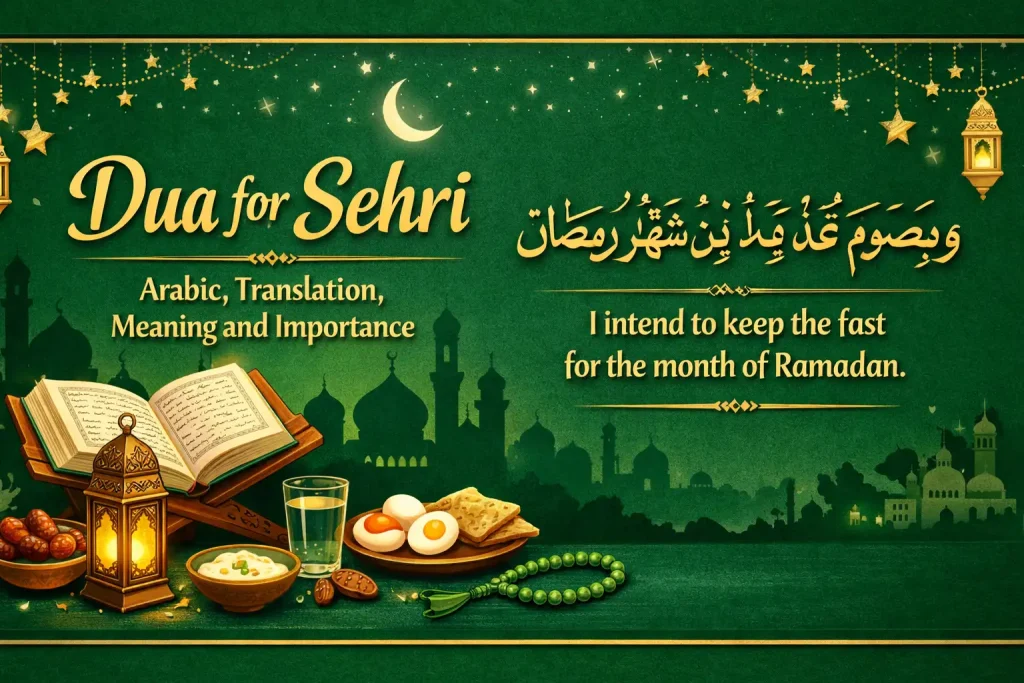
Sehri (Suhoor) is a deeply special and blessed time, filled with Allah’s mercy, barakah, and divine acceptance. It is a moment when even a simple act, eating, transforms into an act of worship.
Reciting the dua for Sehri helps a believer connect their intention with Allah, while also preparing them mentally and spiritually for the fast ahead. It is not merely a declaration of intention to fast, but a powerful means of seeking Allah’s blessings and strength throughout the day.
In this article, you will learn the authentic Sehri dua, its Arabic text, translation, meaning, and the Islamic wisdom behind making dua at Sehri.
Importance of Sehri in Islam
Sehri, also known as Suhoor, is the pre-dawn meal taken before fasting begins in Ramadan. Islam highly encourages Sehri because it carries many physical and spiritual blessings, as mentioned by the Prophet Muhammad ﷺ in one of his Hadiths.
“Take Suhoor, for indeed there is blessing in Suhoor.”
(Sahih Bukhari 1923, Sahih Muslim 1095)
This Hadith clearly shows that Sehri is not just a meal; it is a Sunnah filled with barakah.
Dua for Sehri in Arabic with Translation
There is no specific fixed dua for Sehri that the Prophet ﷺ recited, as no such narration is found in the Hadith. However, many Muslims recite this dua at the time of making the intention for Sehri, which is permissible, and it also carries spiritual benefits.
وَبِصَوْمِ غَدٍ نَّوَيْتُ مِنْ شَهْرِ رَمَضَانَ
English Translation
“I intend to keep the fast for the month of Ramadan.”
This dua can also be recited as well.
نَوَيْتُ صَوْمَ غَدٍ عَنْ أَدَاءِ فَرْضِ رَمَضَانَ لِلّٰهِ تَعَالٰى
English Translation
“I intend to fast tomorrow for the obligatory fast of Ramadan for the sake of Allah Almighty.”
What if you forget reciting the Dua for Sehri?
Reciting the dua for Sehri (Suhoor) is not obligatory for the fast to be valid. As the Prophet Muhammad ﷺ taught in his famous Hadith, actions are judged by intentions, and intention (niyyah) is an inner resolve of the heart, not merely words spoken on the tongue. Therefore, if someone forgets to recite the dua for Suhoor, their fast remains valid.
However, reciting the dua for Suhoor is highly recommended, as it is a means of seeking Allah’s blessings, spiritual reward, and divine assistance throughout the day of fasting.
Spiritual Benefits of Sehri Dua
The meaning of the sehri dua reflects sincerity, obedience, and submission to Allah’s command. By making intention at Sehri, a Muslim:
- Declares worship purely for Allah
- Mentally and spiritually prepares for fasting
- Turns a daily habit into a rewarded act of worship
FAQs
1. Is there any fixed dua for Sehri in Islam?
No, there is no specific fixed dua that must be recited at Sehri. Any sincere intention in the heart to fast for Allah is sufficient. Reciting a verbal dua is encouraged but not mandatory.
2. What if I forget to make the dua at Sehri?
No, forgetting the dua for Sehri does not invalidate your fast. The intention to fast, even if unspoken, is enough according to the teachings of Prophet Muhammad ﷺ.
3. Can I make any dua during Sehri?
Yes, there is no specific dua prescribed for Sehri. Any dua that is made sincerely from the heart is valid and may be recited.